I spent the whole of the day wondering to myself what I we would do in the class. I had lots of small ideas but I couldn't weave them together to create a coherent class in my mind. The upshot was that I arrived at the dojo without any real clue what I would teach.
Thanks to the guys who helped put out the mats. You know who you are... Or perhaps those who turned up to late too help know who they are...
For inspiration I asked what the guys (no girls today) would like to work on. There was the mandatory request for grading practice but since I am trying to keep away from kata oriented training at the moment I didn't want to get into that. Other than that the guys said they just wanted something new or different from what they are used to.
The general theme of the classes recently was movement but I was thinking to myself that the path to good movement starts in relaxation of the body and mind. And it is my belief that relaxation finds its home in calm, even breathing. So I started off a class aimed at focusing everyone on their breath and had them all running around breathing in different rhythms in time with their running. From this we moved on to using breath to initiate movement. In particular in the form of pushing our partner.
An interesting exercise involved both partners, standing face to face and not moving the feet, trying to push the other over using a single hand. It was obvious that those with more tension in their bodies were easily off-balanced. The analogy was with a plank of wood and a jelly. If you push a vertical, stiff, plank it has no where but to topple over. The jelly can accommodate the push internally and it is harder to push over. The key was to take the partner's push and direct the energy into the ground through relaxed but solid posture, while at the same time trying to find that point in the other person through which you could upset their posture.
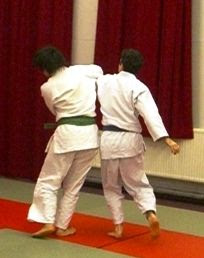
As I suppose was inevitable the pushing lead to simple striking and we looked at both how striking and also taking strikes is affected by your breathing. There are some nice pictures of the guys below avoiding or simply deflecting the energy of the strike using small body relaxed movement and breathing.
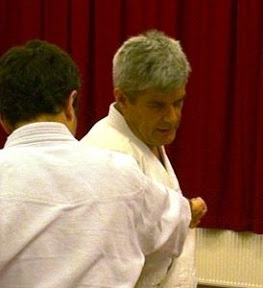
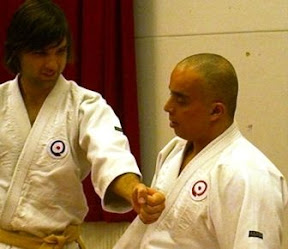
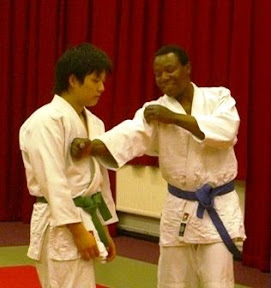
After using movement in breathing to avoid or deflect strikes we then moved up a gear and looked at actually taking the strike. Again this was driven through breathing. It was important to breath as this allows you to keep the defense up while still being free to move. Also holding your breath is really quite tiring! Really, this is not something you would ever aim to do - it is far better not to get hit in the first place - but it is an interesting exercise as it allows you to experience what it is actually like to get hit and also builds confidence in the face of an attacker. The unknown is always more scary than the reality - is this true? The guys did well and I think that they benefited from the opportunity to work outside the comfort zone.
So what about some aikido then?
Well, although atemi (striking) is not allowed in Tomiki aikido competition, and so doesn't feature much in most of the training system, it is actually the case that atemi is vitally important for many techniques to work. The myth that movement alone can always off-balance an attacker is probably based in years of work against ukes who are over extending their attacks. Of course don't get me wrong there are many techniques that can be done without atemi but I believe that some just don't work and most are vastly improved with some suitably timed strikes.
We briefly looked at a few standard aikido techniques where atemi is useful. Tenkai kote hineri is a classic. There are plenty of opportunities to strike the uke, both to help with off-balancing them and also to prevent uke being able to strike or counter your movement. We also looked at slightly unusual versions of oshi taoshi, wake gatame and ude gaeshi.
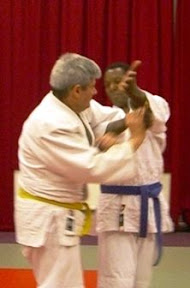
Here is a picture of Andy about to apply a nice atemi with the elbow to Jun before effecting a form of ude gaeshi.
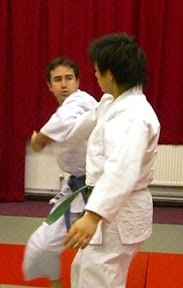
Of course not only is the defender able to use strikes but they should be aware that the attacker may well use them too. This can be very educational. A good way to discover weakness in your technique is to have your attacker pop you one when you have not broken their balance correctly or have not positioned yourself well.
To round up we had a few minutes of free play where atemi was encouraged on both sides. The guys looked good although there was a tendency to stop the movement in order to place the atemi rather than allowing the strike to come freely from the movement of the technique in the first place.
Unfortunately by this time we had all forgotten that we were supposed to be focusing on our breath (including me) but I think it was fun to experiment with some striking and to see how this fits into aikido, which many people believe is not a striking art.
Thanks to all those who turned up and see you in two weeks.

